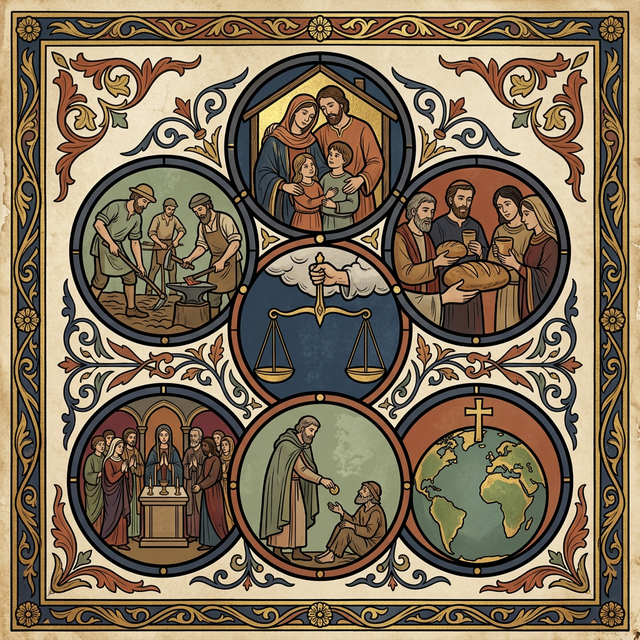
In the boundless tapestry of divine revelation and the perennial wisdom of the Catholic Church, one mystery shines as the incandescent sun, illuminating all others: the Most Holy Eucharist. It is, as the Second Vatican Council profoundly proclaimed, the 'source and summit of the Christian life' (Lumen Gentium, 11), a sacrament so sublime, so utterly central, that without it, the Church herself would cease to breathe the very life of Christ.
For centuries, from the solemn secrecy of the catacombs to the soaring arches of Gothic cathedrals, the faithful have found in this sacred repast not merely a symbol, but the very Real Presence of our Lord Jesus Christ—Body, Blood, Soul, and Divinity—hidden beneath the humble appearances of bread and wine. For the neophyte, it is a sublime introduction to the heart of our Catholic faith; for the lifelong Catholic, an inexhaustible fount of grace and contemplation, ever inviting deeper adoration and understanding.
The Ancient Roots and Institution of a Divine Covenant
To comprehend the Eucharist in its full majesty is to trace a sacred lineage stretching back to the Old Covenant. The Passover, that foundational event of Israel's liberation from Egyptian bondage, with its sacrificial lamb and unleavened bread, served as a profound prefigurement of the salvific act yet to come. It was Christ Himself, the New and Eternal Paschal Lamb, who would fulfill these ancient rites beyond all expectation.
On the eve of His Passion, gathered with His beloved Apostles in the Upper Room, Our Lord instituted this Sacrament of Sacraments. As narrated with divine precision in the Gospels and by St. Paul, He took bread, blessed it, broke it, and gave it to them, saying, 'Take and eat; this is My Body.' Then, taking the cup of wine, He blessed it and said, 'Drink from it, all of you, for this is My Blood of the covenant, which will be shed on behalf of many for the forgiveness of sins' (Matthew 26:26-28). With the irrevocable command, 'Do this in memory of Me,' (Luke 22:19) He bestowed upon His Apostles, and their legitimate successors, the priesthood and the sacred power to perpetuate this divine sacrifice until the glorious consummation of all ages.
From that foundational moment, the early Church held fast to this sacred meal as the very core of its communal life. The Acts of the Apostles recounts how the first Christians 'devoted themselves to the apostles’ teaching and fellowship, to the breaking of bread and the prayers' (Acts 2:42), signifying the Eucharist as the enduring wellspring of their unity and grace.
The Profound Mystery of Real Presence and Transubstantiation
Central to the unwavering Catholic understanding of the Eucharist is the doctrine of the Real Presence—the immutable belief that what appears to our senses as mere bread and wine truly and substantially becomes the living Christ. This is not a fanciful metaphor or a mere spiritual presence, but a substantial, physical, and divine reality. Our Lord Himself unequivocally declared, 'Truly, truly, I say to you, unless you eat the flesh of the Son of Man and drink His blood, you have no life in you' (John 6:53).
The Church articulates this profound, miraculous transformation through the venerable theological term 'Transubstantiation.' This term, refined over centuries of theological reflection and solemnly defined by the Fathers of the Council of Trent, teaches that at the consecration during the Holy Mass, through the efficacious power of the Holy Spirit and the priestly words of institution, the entire substance of the bread is changed into the substance of the Body of Christ, and the entire substance of the wine is changed into the substance of His Blood. The 'accidents'—the visible properties such as taste, texture, and appearance—miraculously remain, but the underlying 'substance' is wholly transformed. It is a divine miracle wrought by God, transcending human reason and demanding the profound assent of faith.
“No other sacrament has greater healing power; by it sins are purged away, virtues increased, and the soul is satiated with an abundance of all spiritual gifts.”
— St. Thomas Aquinas, Doctor of the Church, Summa Theologiae, III, q. 79, a. 1, ad 2
Nourishment for the Soul and Intimate Communion with Christ
Why does our Lord, in His infinite wisdom and love, offer Himself to us in such a hidden, humble way? Because He knows our deepest spiritual hunger. The Eucharist is our true spiritual food, sustaining us on our arduous pilgrimage through life, granting us strength for the journey and hope for eternity. Receiving Holy Communion, when one is properly disposed and in a state of grace, brings forth an ineffable abundance of divine graces:
- Intimate Union with Christ: We are united to Him in a most profound and personal way, becoming 'one spirit' with Him, drawing ever closer to His Sacred Heart.
- Increase of Sanctifying Grace: Our immortal souls are nourished and strengthened, enabling us to grow significantly in holiness, virtue, and resemblance to Christ.
- Purification from Venial Sins: While not a sacrament for the forgiveness of mortal sins (for which the Sacrament of Reconciliation is necessary), it cleanses us from venial faults and imperfections, drawing us closer to purity of heart.
- Preservation from Future Mortal Sins: It fortifies our spiritual resolve against temptation and keeps us firmly tethered to God's preserving grace, guarding us from falling into grave sin.
- Integration into the Church: It dynamically builds up the Mystical Body of Christ, uniting us more closely with all the faithful throughout the world and across time, in one communion of saints.
- A Pledge of Future Glory: It is a blessed foretaste of the heavenly banquet, a tangible promise and guarantee of eternal life with God in the Beatific Vision.
Each reception of the Eucharist is not merely a ritual performance, but a deeply personal, transformative encounter with the living God, a moment of profound spiritual sustenance that transforms us from within, making us truly partakers of the divine nature.
Living a Eucharistic Life: A Call to Deeper Devotion
Understanding the sublime reality of the Eucharist calls us to a deeper, more fervent living out of our Catholic faith. It compels us to:
- Reverence and Preparation: We must approach this Sacrament with profound respect, ensuring we are in a state of grace (confessing mortal sins before reception) and observing the prescribed Eucharistic fast as an act of loving anticipation.
- Active Participation at Mass: Engage fully and consciously in the Holy Sacrifice, uniting our own prayers, intentions, and even our very lives with Christ's perfect and eternal offering to the Father.
- Eucharistic Adoration: Extend our communion beyond the Mass by spending devout time in adoration before the Blessed Sacrament, offering silent praise, heartfelt petition, and profound thanksgiving to Our Lord truly present in the tabernacle.
- Living Charity and Mission: Transformed by the very Body and Blood of Christ, we are called to become His hands and feet in the world, serving others with the same selfless, self-giving love we receive. The Eucharist compels us to live a life of profound charity, compassion, and mission, bringing Christ to those in greatest need.
Let us never grow accustomed to this infinite miracle, this supreme gift of divine love that surpasses all understanding. The Holy Eucharist is not merely an obligation but an intimate invitation—an invitation to sit at the table of the King of Kings, to be fed by His very Self, and to be strengthened with supernatural fortitude for the journey toward our eternal home in His heavenly Kingdom.
As Sanctus Mission strives diligently to nourish souls through faithful formation and to support those apostolates spreading His truth and love across the globe, let us ever return to this divine wellspring, the Most Holy Eucharist. May we continually seek to deepen our understanding, our devotion, and our love for this sacred mystery, allowing its transformative power to mold us more perfectly into the very image of our Eucharistic Lord, for the glory of God and the salvation of souls.